By Sandrine Saison-Marsollier, Educational Specialist
Article at a glance
By exploring the relationships between adults, children and young people, as well as their respective needs, this article invites parents and teachers to question their educational practices and offers concrete tools to support their reflection.
Keywords: quality relationships, emotional regulation, availability, rules for living together, needs
Introduction
“Being a parent, being a teacher: the most beautiful and most difficult jobs in the world.” This phrase is widely echoed in public debate. It reflects the concerns surrounding the education of children and young people. Current social and cultural transformations are profoundly reshaping forms of educational authority. It is therefore necessary to rethink the educational frameworks that underpin child/adult relationships. Today’s young people are growing up in a more individualised and interconnected world, marked by immediate and extensive access to information, which gives rise to new educational challenges. At the same time, the rise in anxiety and depressive disorders among young people (OECD, 2026) is further intensifying questions around education and making it a central concern. Rather than stopping at this twofold observation — social change and psychological distress — it is useful to refocus the reflection on the three main areas presented below, in order to define the issue more clearly and encourage action.
Quality relationships: Establishing a bond based on mutual respect, consideration and trust, while keeping in mind the asymmetrical nature of educational action: it is not fair to demand respect and consideration from a child if adults themselves do not model respect and consideration.
Shared rules for living together: Defining explicit rules by distinguishing between what is non-negotiable and what can be discussed. Rules also apply to adults and, in most cases, can be co-decided.
Autonomy and responsibility: Gradually supporting the child or adolescent in their development so as to strengthen their ability to make informed choices.
The aim is therefore to promote an educational approach that combines a structuring framework with an empathetic stance, in which the adult remains the guarantor of authority.
How can quality relationships be built?
Building a quality relationship, whether at school or within the family, is based on three pillars: mutual respect, consideration and trust. Respect cannot be imposed; it is built day by day through the adult’s role-modelling, sincere words, attentive listening and genuine recognition of the other person. Considering the child, and being considered by them, means recognising one another as full persons through gestures, smiles, looks, words and concrete actions.
“I exist in the other person’s gaze; the other person exists in my gaze.” Robert Neuburger
This quality of relationship is built gradually through the adult’s exemplary behaviour, as well as through regular, sincere and reassuring interactions. The relationship with adults plays a central role in children’s well-being and development. The findings of the literature review conducted by Claude Martin, Zoé Perron and Julia Buzaud (2019) converge in placing the relationships that children and young people have with those close to them, especially their parents, at the heart of the factors that determine child and youth well-being in France.
Availability and emotional regulation
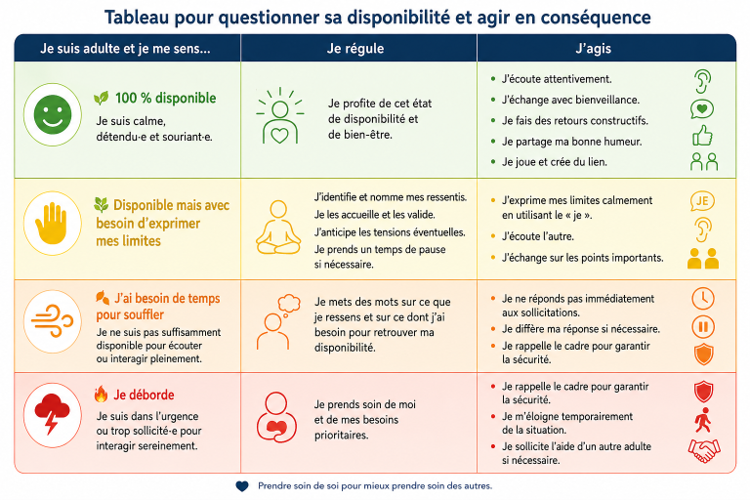
A quality relationship is made possible by the adult’s availability and their ability to regulate their emotions. For the adult, this means finding the right balance between presence and autonomy. The challenge is to be attentive, to listen genuinely, to encourage and to provide constructive feedback, while leaving the child the space they need to develop.
In this process, emotional regulation is central. Adults, like children, experience intense emotions: learning to step back, delay a reaction or calm down helps everyone avoid escalation and protect the relationship. Consistency between the adult’s words and actions, as well as continuity between educational practices at school and at home, strengthens trust and the legitimacy of authority.
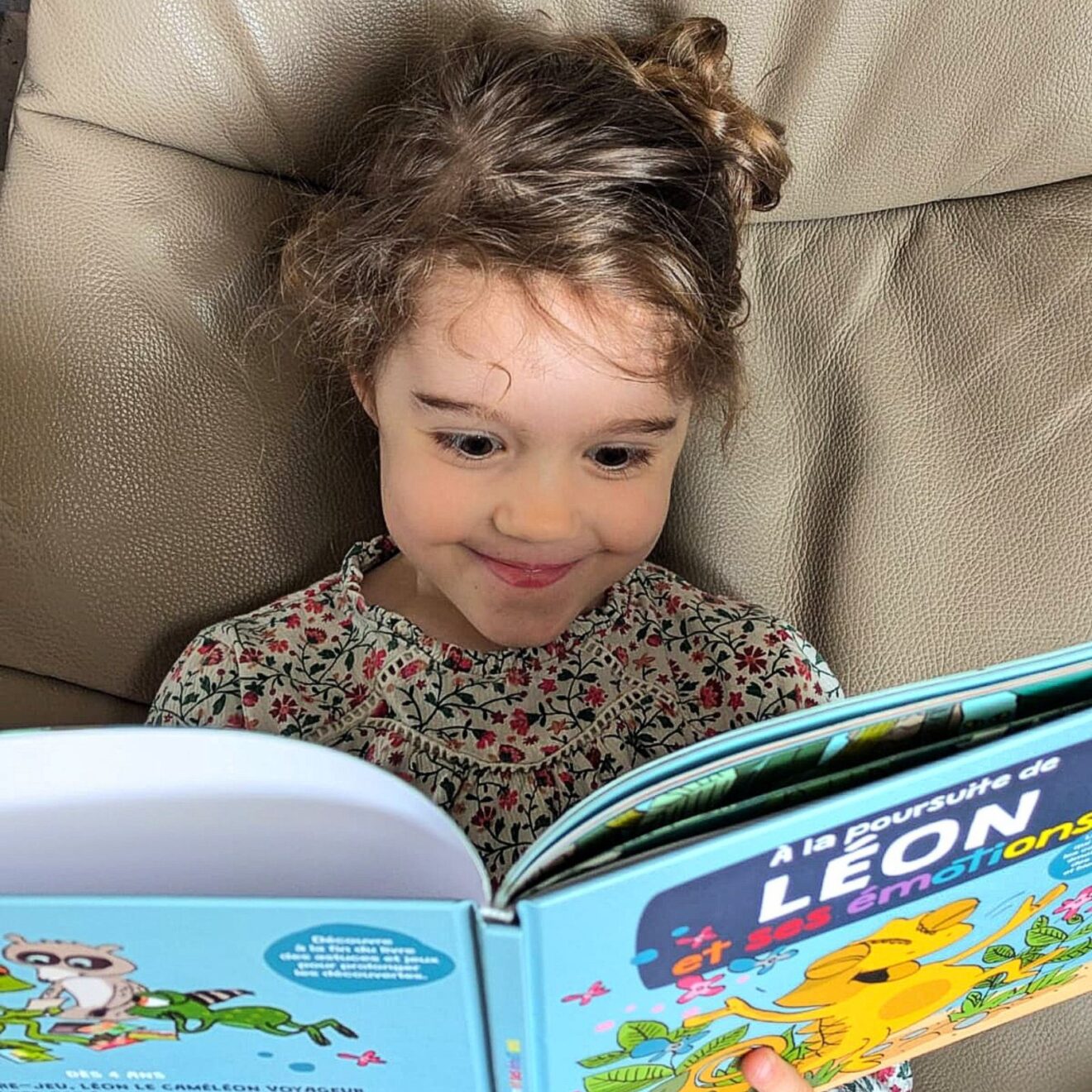
Within the family, sharing a meal, talking during a journey, playing, cooking or reading a story all create and sustain the relationship. These shared moments nurture the bond and contribute to the construction of the child’s identity.
At school, positive interactions between teachers and pupils — small-group work, encouragement, caring exchanges or fair redirection — also contribute to children’s well-being. They reduce behavioural difficulties and support learning. It is therefore important to offer teaching activities that foster these positive relational dynamics in the classroom. The four volumes in the Growing up in Peace collection make this work possible.
At school, positive interactions between teachers and pupils — small-group work, encouragement, caring exchanges or fair redirection — also contribute to children’s well-being. They reduce behavioural difficulties and support learning. It is therefore important to offer teaching activities that foster these positive relational dynamics in the classroom. The four volumes in the Growing up in Peace collection make this work possible.
How can shared rules for living together be established?
Jean-Paul Gaillard (2023) reminds us that we have entered a new educational era: models based on obedience and vertical authority no longer correspond to today’s realities. Rethinking the framework therefore requires concrete adjustments, adapted to each context, with a clarification of the limits that fall under the adult’s responsibility.
An educational framework is essential in order to secure the relationship. The aim is not to multiply rules, but to make them clear, coherent and fair. A distinction can therefore be made between:
- Non-negotiable rules: linked to safety and health, including the use of digital technology — time, places and content — and to human values such as respect, justice and fairness.
- Negotiable rules: discussed and adjusted according to situations and the child’s age.
The adult defines the non-negotiable rules, explains them and takes responsibility for them. These rules evolve as the child develops. The adult decides on the rules not because they “dominate” the child, but because they have a major responsibility towards them: these non-negotiable rules exist to guarantee the child’s safety and health, and the adult has more in-depth knowledge of these subjects. This decision-making power entails significant responsibilities and, once again, exemplarity is often more essential than words that are not embodied in action.
Towards a clarified framework: non-negotiable / negotiable
This distinction helps clarify expectations, reduce tensions and involve the child in understanding the framework. When non-negotiable rules are not respected, the response should involve restorative rather than punitive consequences. When there has been a breach, restorative consequences aim to give meaning to the outcome: repairing, apologising, putting things back in order or contributing to the situation concerned.
Examples of non-negotiable rules
- Screen time: duration of use adapted to the child’s age (see the recommendations of the French government). https://jeprotegemonenfant.gouv.fr/ecrans/)
- Sleep: respect for age-appropriate schedules.
- Safety and living environment: essential protective rules.
- Human values: the unacceptability of all forms of violence.
- Going out: agreed times set and respected, for example returning home at a defined time at the weekend.
This framework, both clear and evolving, supports the child’s progressive development of responsibility while maintaining a secure and structuring environment.
The adult acts as a model in respecting this framework and the rules for living together. In this respect, they show exemplarity by recognising and repairing their own mistakes when they adopt inappropriate behaviour. For example, they apologise to a child if they have hurt their feelings. Through their own behaviour, they also demonstrate the attitudes expected when interacting with other adults. Repair should not be seen as a systematic response or a “catch-all” concept that avoids questioning one’s own practices. On the contrary, it is part of a reflective approach based on stepping back, observing and analysing one’s own professional stance.
Educational framework: a renewed view of behaviours
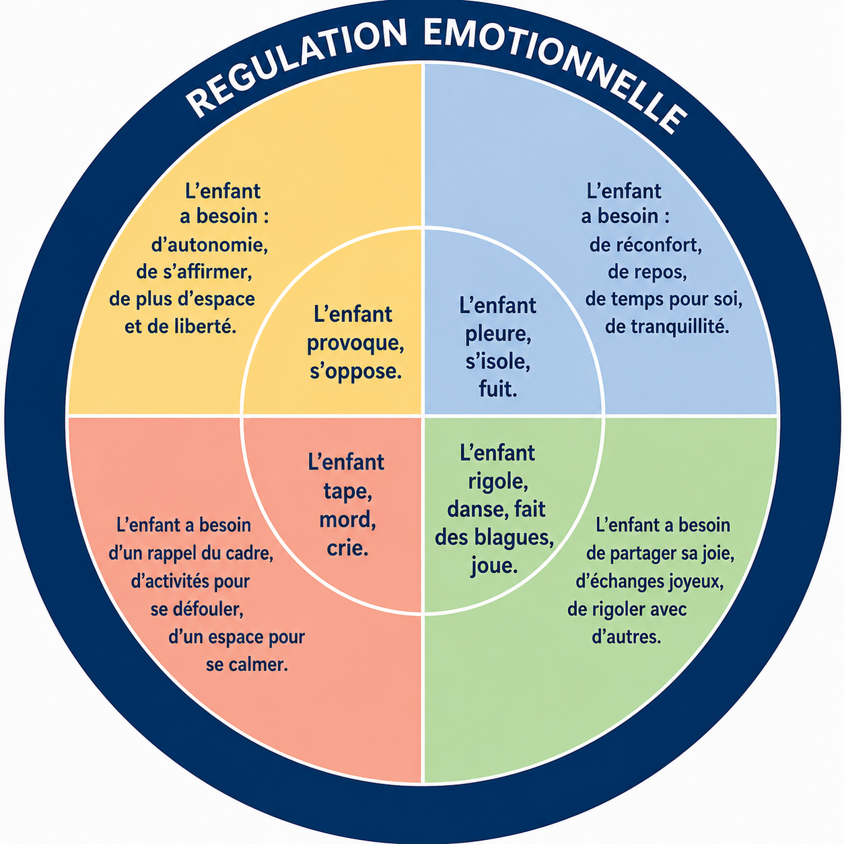
Adjusting responses to children’s behaviours requires a stance of stepping back and observing. The idea is to better understand the needs and emotions that underlie actions and words. Parents and teachers are therefore invited to develop a central skill: observation. Taking the time to look, listen and question what the child is experiencing helps us better understand their reactions and respond more appropriately. In the same way, taking the time to observe one’s own reactions makes it possible to adjust one’s responses towards children.
Children’s behaviours can be better understood when we look at what underlies them: emotions, needs and frustrations. As Edouard Gentaz (2023) explains, difficult behaviour is often the expression of an unmet need or a difficulty in regulating an emotion. Identifying these signals makes it possible to intervene in a fairer and more respectful way.
This approach transforms the educational relationship: the adult no longer simply reacts to the visible behaviour, but seeks to understand its origin. This allows for a response that is both firm about the framework and attentive to the person. The point is not to accept everything — non-negotiable rules still apply, even when the emotion is understood — but to understand better in order to intervene better.
This interpretive framework links observed behaviours — at the centre of the wheel — with the child’s presumed needs. It makes it possible to reconcile high expectations with kindness. When a child feels understood, they are more able to cooperate and integrate the rules. The framework is, of course, not exhaustive. It presents needs that are often associated with certain behaviours. Other needs may need to be explored with the child or with the help of a healthcare professional, especially where there are signs of persistent distress.
How can autonomy and responsibility be built progressively?
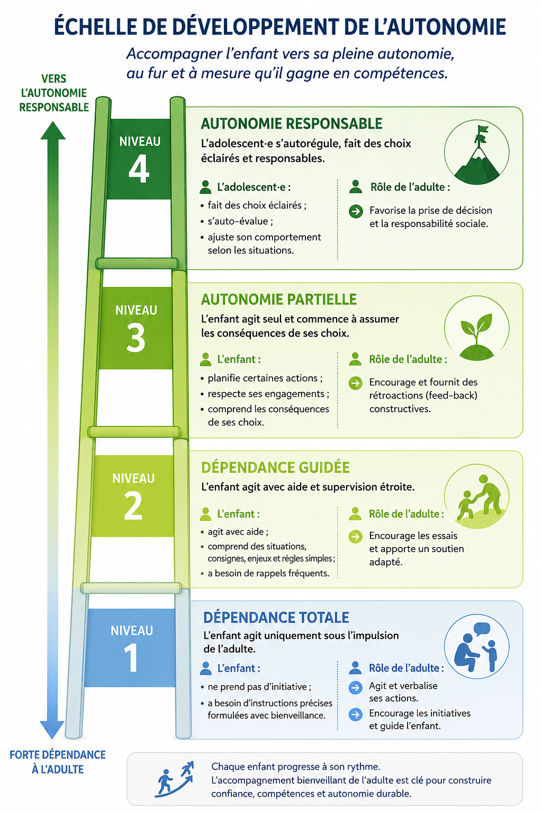
L’autonomie et la responsabilité ne se décrètent pas : elles se construisent progressivement dans un environnement à la fois structurant et soutenant. François Taddéi (2018) met en avant l’importance de développer des formes d’apprentissage qui encouragent la curiosité, l’initiative et la capacité à apprendre à apprendre, dans une logique de responsabilisation graduelle des enfants et des jeunes. Dans le domaine scolaire, Philippe Meirieu (2021) rappelle également que l’autonomie de l’élève se développe grâce à un cadre exigeant mais bienveillant, permettant l’exercice progressif du choix et des responsabilités.
“Everything that is done for me, without me, is done against me.” Nelson Mandela
This quote by Mandela resonates with the scale of autonomy and responsibility proposed here. It represents an evolving pathway: moving from dependence to autonomy requires constant support, based on relationships, framework and trust, both at the heart of school learning and within the family.
Conclusion
What if none of this works? Some children, particularly those with behavioural disorders or traumatic experiences, do not respond immediately to this approach. In such cases, maintaining the framework — with clear and predictable consequences — and seeking specialised support, such as child psychiatrists, psychologists or early childhood educators, may be necessary.
Educating today is not simply about imposing rules. It is about combining a clear framework, fair authority, availability and understanding. When the adult takes the time to understand the child, clarify the framework, uphold the non-negotiables and respond to the child’s needs, they foster trust, cooperation and development. This approach transforms the educational relationship: it makes authority more legitimate, rules more acceptable and support more effective. By focusing on the bond as much as on the framework, parents and teachers give young people the conditions they need to grow with confidence and fully develop their potential.
Moreover, adults have a responsibility to engage in this work of self-knowledge: children learn by example. An adult who is able to identify, name, regulate and respectfully express their own emotions and needs embodies this stance of fair authority for the child. Exemplarity is a form of authority.
Bibliography:
Bilheran, A. (2009). L’autorité. Paris, France : Armand Colin.
Gaillard, J.-P. (2023). Enfants et adolescents en mutation : mode d’emploi pour les parents, éducateurs, enseignants et thérapeutes. Paris, France : ESF Éditeur.
Gentaz, É. (2023). Comment les émotions viennent aux enfants. Paris, France: Nathan.
Greene, R. W. (2017). L’enfant explosif. Consulté à l’adresse : L’enfant explosif (PDF)
Martin, C., Perron, Z., & Buzaud, J. (2019). Le bien-être de l’enfant : évolution d’une notion, ambiguïtés des dimensions et mesures. Enfances, Familles, Générations, (33). https://journals.openedition.org/efg/9185
Meirieu, P. (2021). Dictionnaire inattendu de pédagogie. Paris, France : ESF Éditeur.
Neuburger, R. (2023). Exister : le plus intime et fragile des sentiments. Paris, France : Payot.
Reynal, I., Mella, N., Gentaz, É., & Richard, S. (2025). Mieux comprendre la régulation émotionnelle chez les enfants de 5-6 ans : type de stratégies et lien avec la compréhension des émotions. L’Année psychologique, 125(3).
Robbes, B. (2014). L’autorité éducative : la construire et l’exercer. Repères pour agir . Paris, France : Réseau Canopé (SCÉRÉN).
Taddéi, F., & Pasquinelli, E. Podcast France Culture Être et Savoir : Quelles nouvelles pédagogies pour demain ? https://www.radiofrance.fr/franceculture/podcasts/etre-et-savoir/apprendre-au-xxieme-siecle-avec-et-par-la-science-9805823
To find out more, please contact our pedagogical department: : info@grainesdepaix.org