By Laura Ducastel, Psychologist & Expert in Innovative Training (2026)
Article at a GlanceL’article en bref
By questioning the role of “positive emotions” in educational and societal contexts, this article offers a systemic reflection and presents concrete experiments to be implemented both at school and at home.
Keywords: positive emotions, life skills, educational and societal transformation, desirable futures
Introduction
Long ignored by research, or even considered of little interest (Quoidbach, 2014), positive emotions are now an integral part of studies on human flourishing and the optimal functioning of individuals, groups, and institutions (Gable & Haidt, 2005). Yet their very success exposes them to a double reduction: a psychological one and a normative one. Confused with “positive thinking” and instrumentalized by organizations seeking low-cost resilience, they sometimes become an injunction to individual happiness that obscures structural responsibilities (Cabanas & Illouz, 2018). In school settings, this drift is particularly concerning. Research indeed shows that mental health interventions produce lasting effects only when supported by inclusive practices and strong institutional leadership (INSPQ, 2026).
This article therefore does not aim to add another layer of “positive gloss” to contemporary educational challenges. Rather, it seeks to shift the perspective: what if positive emotions were neither goals to be achieved nor mere adaptive tools, but indicators of what, in our collective ways of doing, truly supports learning and living together? Building on a systemic and critical analysis, we explore this avenue through concrete examples (the positive emotions flower, rituals for sharing successes, savouring) that anchor emotions in cooperation and mutual recognition. Our hypothesis is that, when connected to inclusive, reflective, and systemic practices, positive emotions can become compasses for enriching meaningful educational narratives and for opening up, at children’s level, other possible futures.
What Are Positive Emotions and What Are They Really For?
How Can They Be a Resource in the World of Education?
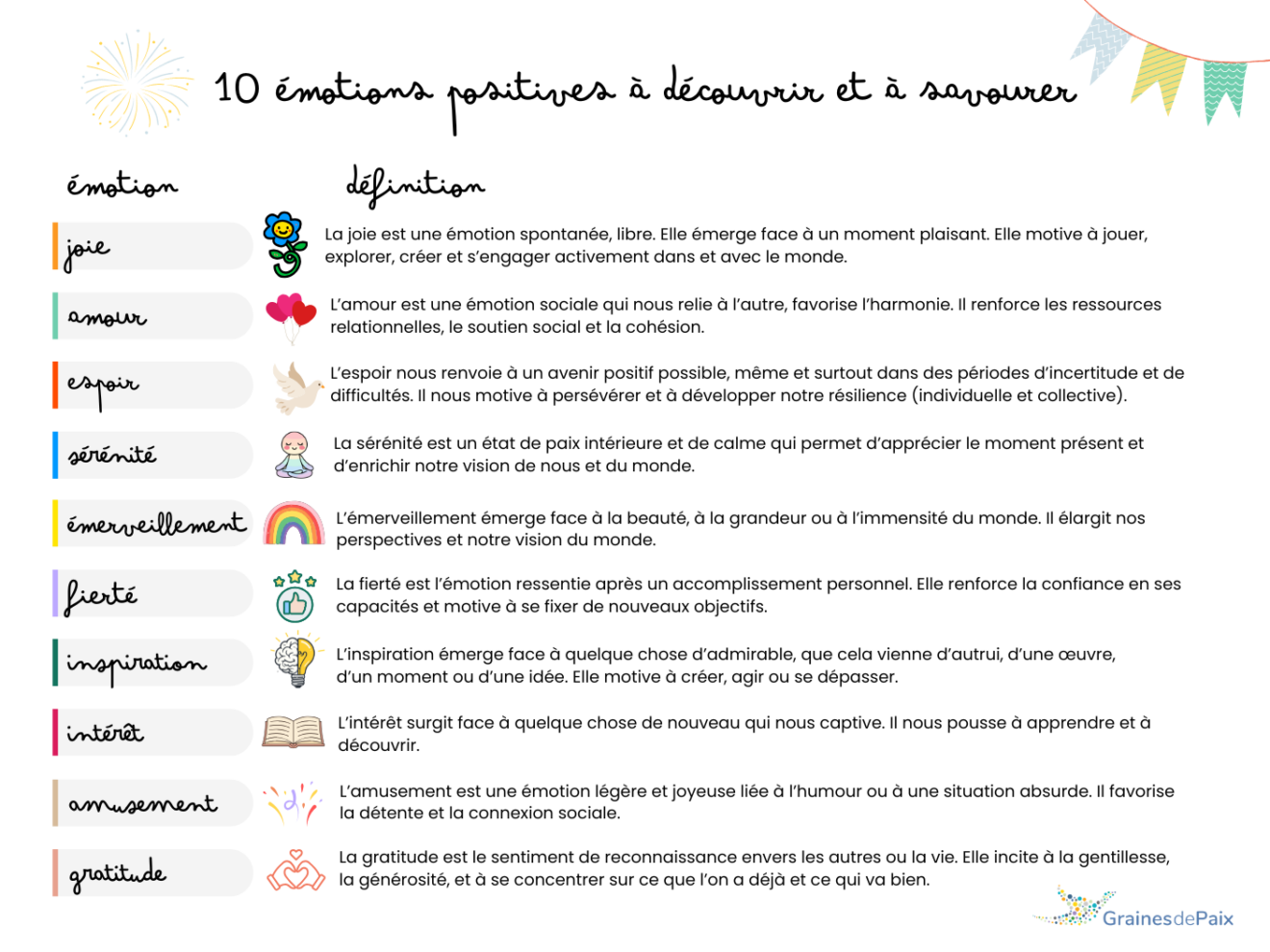
Psychological research long focused on fear, anger, sadness, and disgust—emotions with a major evolutionary function, as they enable us to survive and respond to immediate threats in our environment (Quoidbach 2023). Since the late 1990s, however, driven by the work of researcher Barbara Fredrickson, positive emotions (joy, gratitude, interest, pride, awe, calm, etc.) have been defined as pleasant affective states that, like all emotions, involve a situational component (e.g., meeting someone you appreciate in the street), a cognitive component (e.g., appraising this encounter as positive), and a physiological component (e.g., increased heart and breathing rates, and the release of neurotransmitters such as dopamine or oxytocin) (Palazzolo, 2024).
Positive emotions play a role in broadening and building resources (Fredrickson, 1998, 2001)—intellectual, social, psychological, and physical—in a lasting way, even in times of crisis (Fredrickson, 2003). Below is a non-exhaustive overview of the benefits identified through the experience and expression of positive emotions (see Lyubomirsky et al., 2005; Diener et al., 2002; Isen, 1999; Danner et al., 2001):
- They increase creativity, flexibility, inventiveness, and problem-solving abilities;
- They are associated with greater relational effectiveness (leadership, cooperation, negotiation) and an enhanced ability to mobilize opportunities, whether professional or social;Elles sont corrélées à une plus grande efficacité relationnelle (leadership, coopération, négociation) et à une meilleure capacité à mobiliser des opportunités, qu’elles soient professionnelles ou sociales;
- They increase the tendency to engage in a wide range of activities: playing, exploring the environment, engaging in physical, social, or leisure activities, initiating conversations with others, and developing broader social networks;
- They enable faster recovery from negative emotions;
- They improve quality of life and overall life satisfaction;
- They strengthen the immune system and extend lifespan (under comparable living conditions!).
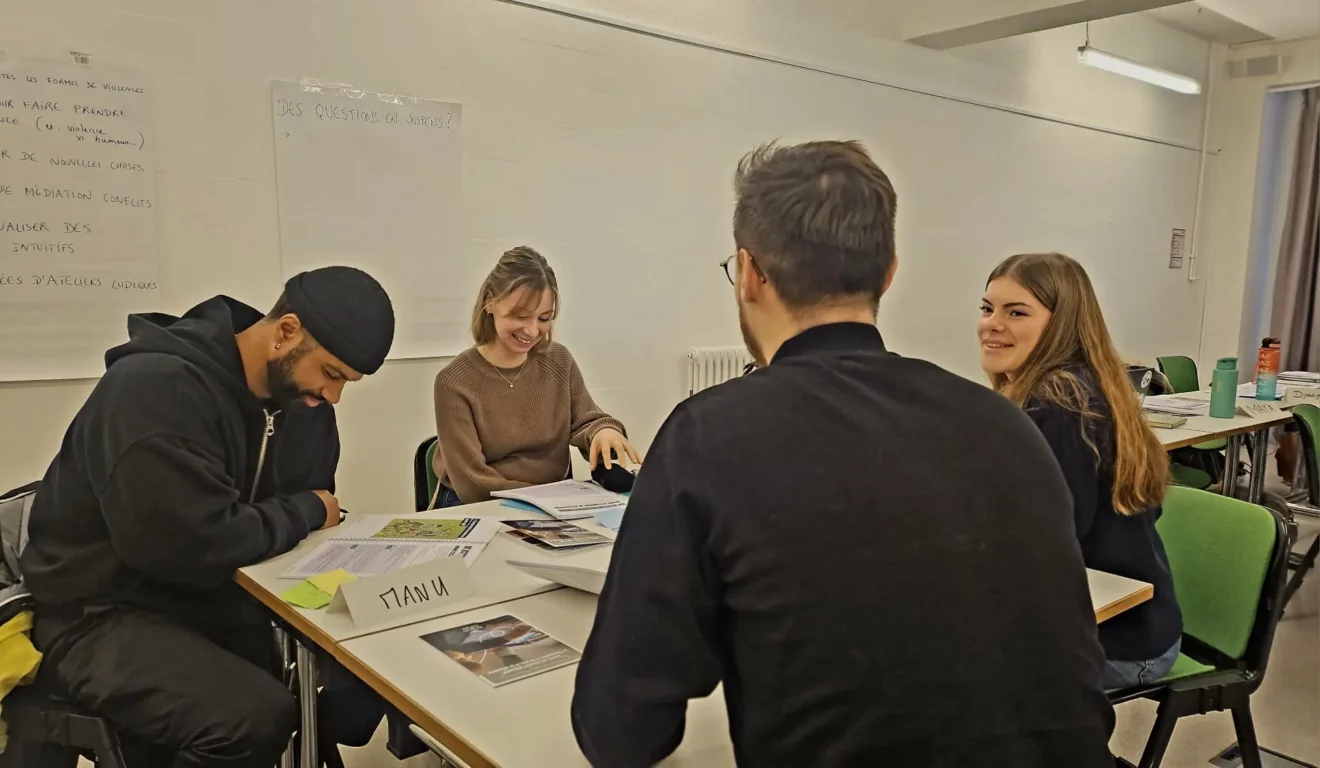
To intentionally foster positive emotions during an AdoGoZen training session (Lausanne, 2026), participants are invited to learn through experiential and collaborative approaches, grounded in action and dialogue. Their feedback reflects “interest” in other participants’ stories, “inspiration” drawn from ideas shared by peers, as well as the “fun” of being able to laugh together, even about difficult situations, and “gratitude” for the mutual support and assistance experienced.
In educational settings, positive emotions are genuine emotional resources, enabling both children and adults to remain motivated, confident, and satisfied with their days and their lives, despite inevitable setbacks (Shankland & Godeau-Pernet, 2025). Learning to identify and cultivate them is fully part of the development oflife skills as defined by Graines de Paix. This practice, known as “savouring” (Shankland et al., 2018), involves training attention toward what is satisfying in our day: positive moments, supportive people, efforts made—and then truly savouring them, that is, intentionally amplifying them by recalling each detail across all dimensions (bodily, emotional, behavioral, and cognitive).
Together, this creates a virtuous circle: positive emotions lead us to develop new resources, which in turn create further opportunities to experience new positive emotions.
We invite you to experience it for yourself: take a deep breath and think of a child’s burst of laughter, the stunning colors of the northern lights, or the comforting taste of a cup of hot chocolate.
All of these sensory experiences—gustatory, visual, tactile, olfactory, or auditory—can be fully appreciated by directing our full attention to them, which in turn sharpens our perceptions (Bryant & Veroff, 2007). These moments, which we often forget to savour due to a lack of habit, time, or energy, can nevertheless contribute to improving life satisfaction, the quality of our relationships, and our motivation to act (Shankland et al., 2018). Moreover, these practices can be shared and experienced collectively, for example through “relational savouring”. which aims to intentionally increase moments of positive connection within relationships (Borelli et al., 2024). So how can we lead by example for our children?

Intentionally connecting with the beauty of a landscape. Let the bodily sensations, thoughts, and emotions arise…
Photo: Noé Marsollier, northern lights observed during the night of January 19–20, 2026, Pays de Gex.
We can begin by teaching children (and learning alongside them—because we only truly transmit what we embody) to name and recognize different positive emotions, so that this vocabulary becomes familiar. To this end, creating a “positive emotions flower” (Ducastel, 2025) offers an alternative to traditional emotion wheels, which generally include only one or two pleasant emotions and therefore lead both children and adults to recognize only those emotions.
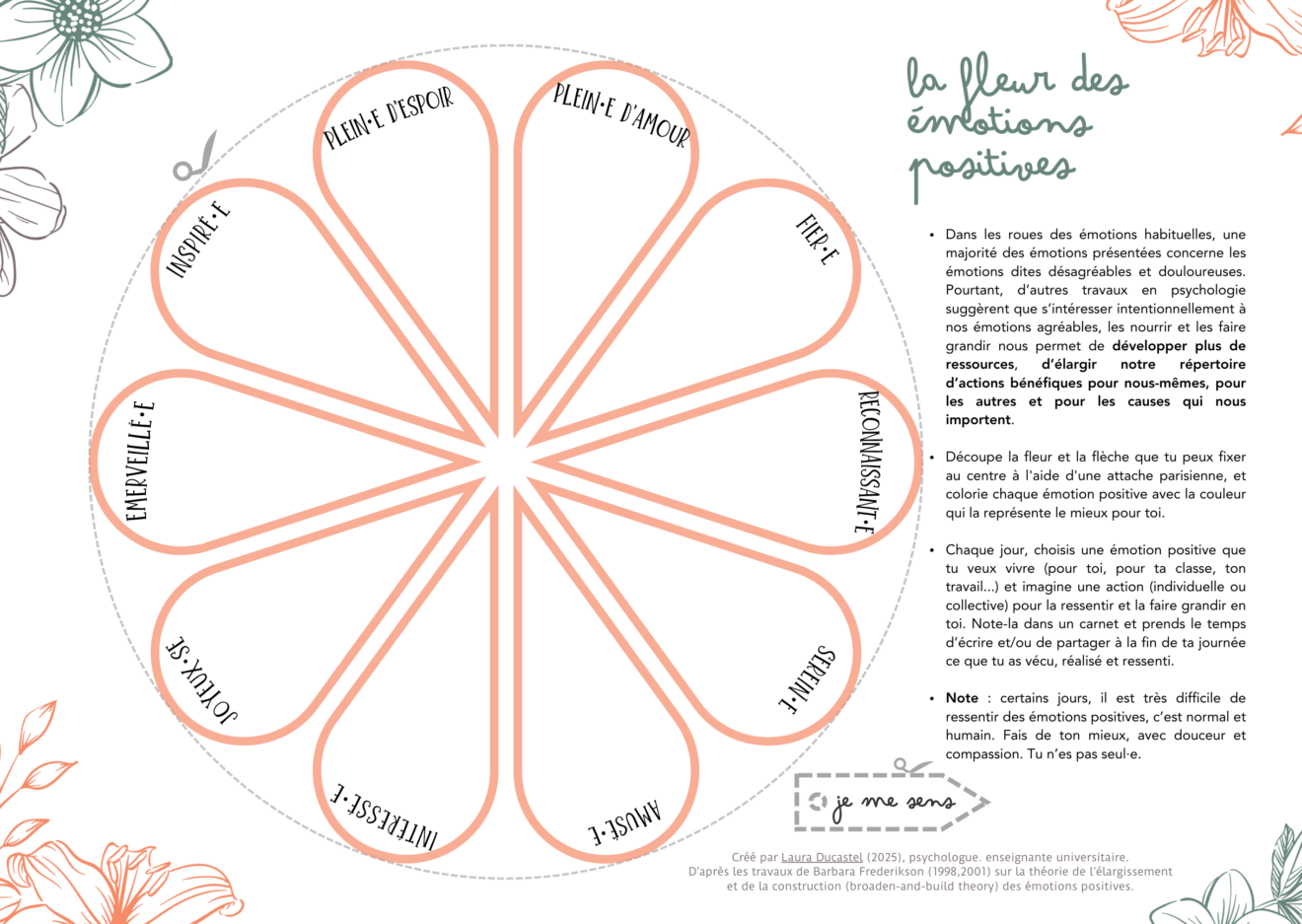
Image 4: The Positive Emotions Flower (Ducastel, 2025 – diagram in French)
Another concrete approach, whether in the classroom or at home, is to establish a “sharing successes” ritual at the beginning or end of the day. An adult invites two or three children to share a recent success—individual or collective. This might involve helping a classmate, solving an exercise together, or resolving a conflict peacefully. The group then helps identify the associated positive emotion (pride, joy, triumph, gratitude, etc.) and reflect on what that emotion makes possible: “What does (name of the emotion) make you want to try next?” “Who helped make this success possible?” “How would you like to celebrate it?”
In just a few minutes a day, this collaborative ritual strengthens two of the three basic psychological needs identified by self-determination theory: the sense of competence and the sense of belonging (Dangouloff et al., 2022). It also anchors positive emotions in relational skills (kindness, cooperation, reflective analysis), establishing them as genuine resources for learning and living together.
Moreover, this ritual introduces children to an elementary form of storytelling about what is going well. Yet it is through narratives that human communities first build and transform their relationship with the world. Training young people in these positive micro-narratives may well give them the capacity, tomorrow, to invent larger ones—to respond to the socio-environmental challenges ahead, for which we have a responsibility to equip and protect them.
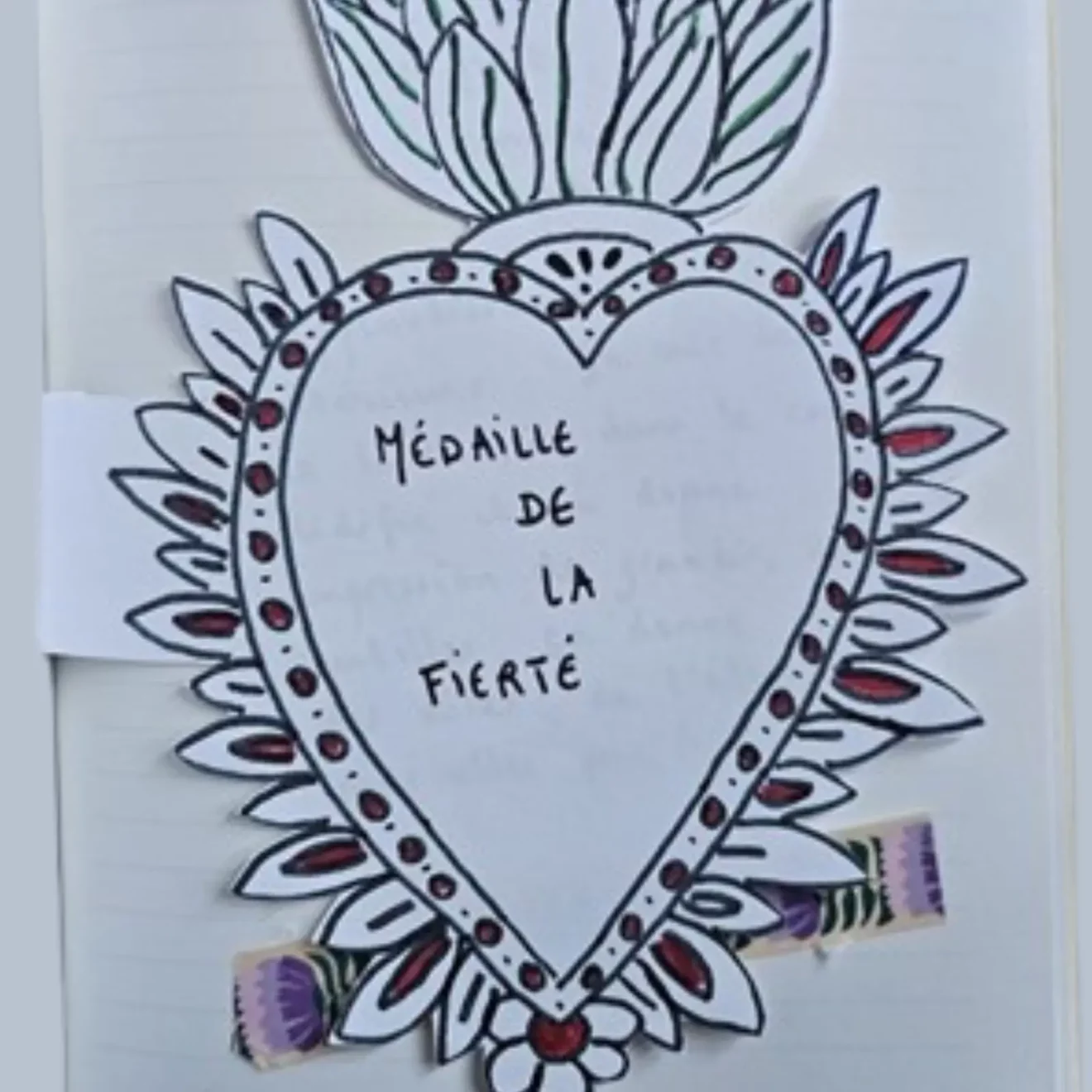
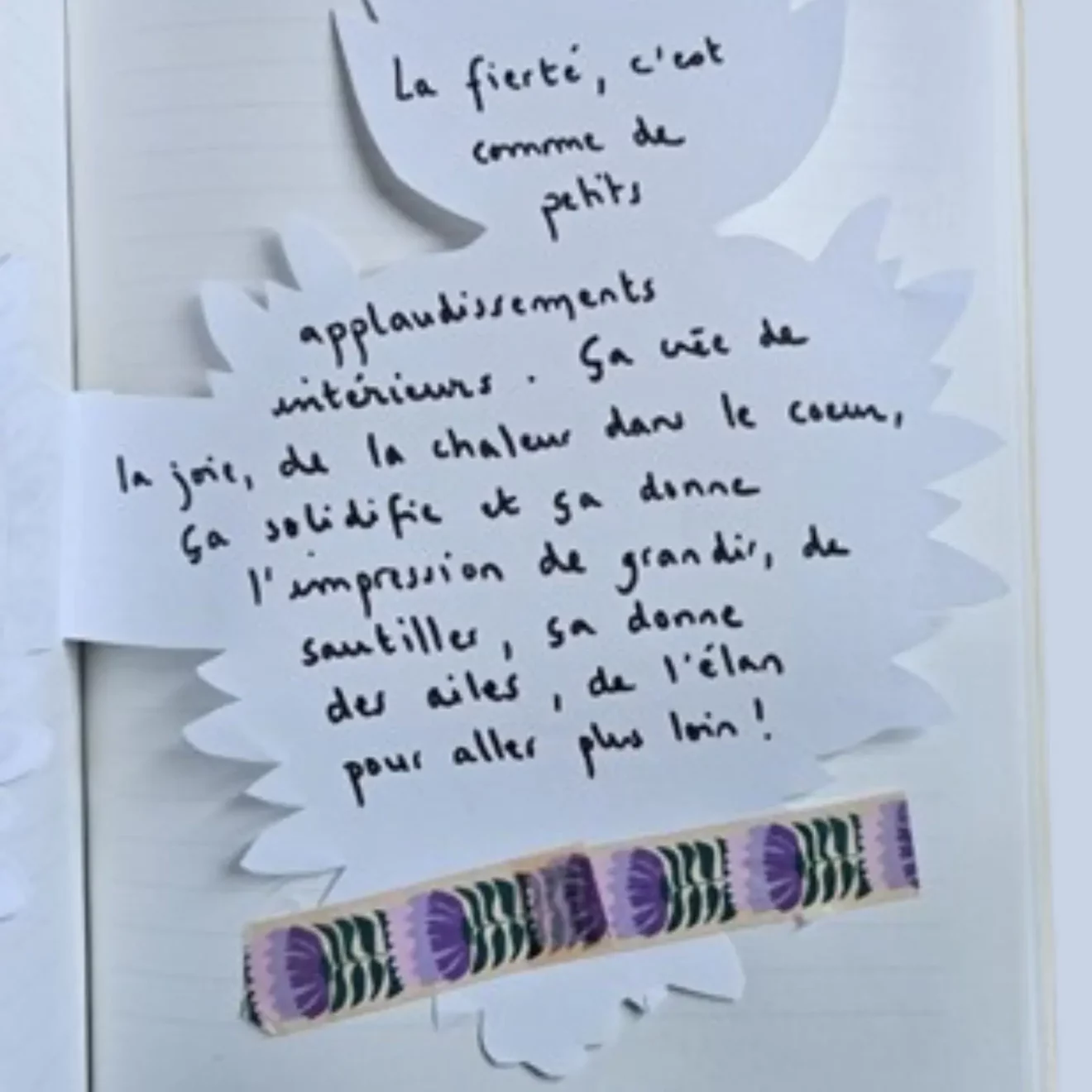
Image 5 (in French): Example of an Activity Linked to the Sharing of Successes – The Pride Medal (Parent–Child Workshop)
Here, each participant (adult and child) creates their own “pride medal,” which is used to collect moments of pride experienced throughout the week and then to share them within the family.
Conclusion
Our experience in research and support has shown that within every institution, every school, and every family, committed adults can improve the daily lives and life trajectories of thousands of children. This improvement comes through creating relational and structural conditions that allow positive emotions to emerge and grow—without denying existing difficulties—and to become resources for learning and living together.
We have proposed viewing these emotions not as ends in themselves, but as indicators of what supports cooperation and engagement, and as levers for highlighting successes, strengthening the sense of competence, and building connections. The concrete and intentional practices described (the positive emotions flower, the sharing successes ritual, and savouring) illustrate this approach: far from being magic tools, they are opportunities for mutual recognition and for giving narrative form to what works, accessible from a very young age.
This approach, which is neither individualistic nor normative, connects positive emotions with social justice and solidarity. It offers concrete leverage points for transforming the educational world, at the level of both children and adults. The status quo is not inevitable: by questioning it together, we can enrich our collective imagination and build new narratives. And these narratives cannot do without joy, love, wonder, or hope.
To Go Further:
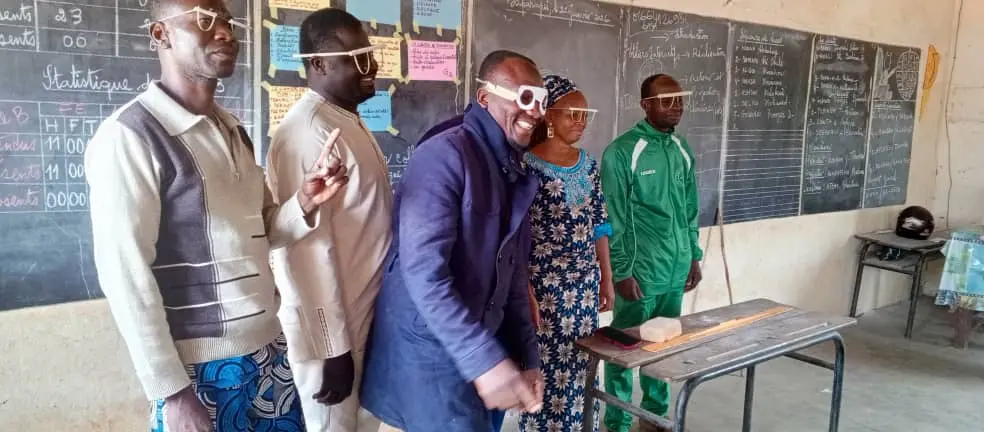
Would you like to experiment with these tools in the classroom or at home? Every two months, new resources are available to download on the academy section of our website. Our Grandir en Paix collection is also available and will help you explore these themes in greater depth. Like other teachers in Switzerland, Benin, or Côte d’Ivoire, you can support children in developing their life skills in a playful way through activities such as “The Qualities Glasses” or “The Kindness Elves” (Graines de Paix, 2016).
Contact us: we look forward to co-creating with you an education that is deeply meaningful and transformative.
Laura Ducastel
Psychologist & Expert in Innovative Training
Bibliography:
Borelli JL, Zhou E, Russo LN, Li FH, Tironi M, Yamashita KS, Smiley PA, Campos B. Culturally adapting relational savoring: A therapeutic approach to improve relationship quality. Fam Process. 2024 Jun;63(2):667-690. doi: 10.1111/famp.12989. Epub 2024 Mar 27. PMID: 38533758; PMCID: PMC11245364.
Bryant, P., & Veroff, J. (2007). Positive psychology: The science of happiness and human strengths. Routledge.
Cabanas, E.and Illouz, E. (2018). Happycratie. Comment l’industrie du bonheur a pris le contrôle de nos vies. Paris, France : Premier Parallèle
Dangouloff, N. ; Tessier, D. et Shankland, R. (2022). Stimuler l’envie d’apprendre – Les leviers de la motivation. Nathan
Danner, D.D., Snowdon, D.A., Friesen, W.V. (2001). Positive emotions in early life and longevity: findings from the nun study. J Pers Soc Psychol.
Diener, E., Nickerson, C., Lucas, R. E., & Sandvik, E. (2002). Dispositional affect and job outcomes. Social Indicators Research, 59(3), 229–259. https://doi.org/10.1023/A:1019672513984
Ducastel, L. (2025). La fleur des émotions positives. https://psy-funambulle.fr/ressources-gratuites-psy-samoens/
Fredrickson, B. L. (1998). What good are positive emotions? Review of General Psychology, 2(3), 300–319. https://doi.org/10.1037/1089-2680.2.3.300
Fredrickson, B. L. (2001). The role of positive emotions in positive psychology : the broaden-and-built theory of positive emotions, in American Psychologist, vol. 56, p. 218.
Fredrickson, B. L. (2003). What good are positive emotions in crises? A prospective study of resilience and emotions following the terrorist attacks on the United States on September 11th, 2001, in Journal of Personality and Social Psychology, vol. 84, p. 365,
Gable, S. L., & Haidt, J. (2005). What (and why) is positive psychology? Review of General Psychology, 9(2), 103–110. https://doi.org/10.1037/1089-2680.9.2.103
Graines de Paix. (2016, 2017, 2018). Grandir en paix, Volumes 1, 2, 3 et 4. Éditions LEP
Institut national de santé publique du Québec. (2026). Environnement social favorable à la santé mentale en contexte scolaire : quelles interventions privilégier ? https://doi.org/10.64490/ROUU6008
Isen, A. M. (1999). Positive affect. In T. Dalgleish & M. J. Power (Eds.), Handbook of cognition and emotion (pp. 521–539). John Wiley & Sons Ltd. https://doi.org/10.1002/0470013494.ch25
Lyubomirsky, S., King, L., & Diener, E. (2005). The Benefits of Frequent Positive Affect: Does Happiness Lead to Success? Psychological Bulletin, 131(6), 803-855. https://doi.org/10.1037/0033-2909.131.6.803
Palazzolo, J. et Midal, F. (2020). La psychologie positive. Presses Universitaires de France.
Quoidbach, J. (2014). Les émotions positives : à quoi servent-elles et comment les savourer ? Dans J. Lecomte (Dir.), Introduction à la psychologie positive. Éditions Dunod.
Quoidbach, J. (2023).La régulation des émotions positives. Dans M. Mikolajczak (Dir.), Les compétences émotionnelles. Éditions De Boeck.
Shankland, R. et Lantheaume, S. (2018). La psychologie positive : 10 fiches pour comprendre le concept. Éditions In Press.
Shankland, R. et Godeau-Pernet, (2025). Bien avec moi, bien avec toi ! Pour découvrir et renforcer tes compétences psycho-sociales. Éditions Nathan.